
Reverse Due Date Calculator
Why This Calculator May Show a Different Date
You may notice that the dates on this page don’t always match results from other pregnancy or conception calculators. That’s because this tool reports an estimated conception date (fetal age) by reversing the usual obstetric dating rule: EDD ≈ ovulation + 266 days.
Many calculators simply subtract 40 weeks (280 days) from the due date and treat that as the first day of the last menstrual period (LMP), then assume conception happened on that same day. In reality, conception usually occurs about two weeks after the start of your period, around ovulation.
This tool instead subtracts about 38 weeks (266 days) from the due date to approximate the actual time of fertilization. That approach gives a clearer estimate of when conception most likely happened, but it can make our result look a little different from sites that still use the 280-day shortcut.
Reverse Due Date Calculator: Find Your Conception & Implantation Window
Enter your due date or an early-pregnancy ultrasound date and this reverse due date calculator will estimate:
- Your estimated conception date (fetal age)
- The most likely intercourse day
- A narrow fertile window and a broader possible window
- Your estimated last menstrual period (LMP)
- A likely implantation window and most likely implantation day
All calculations are based on standard obstetric timelines and are intended for education and reassurance—not as a diagnosis or a substitute for your clinician’s advice.
How to Use the Reverse Due Date & Implantation Calculator
Using the tool takes less than a minute. Choose the input method that matches the information you have: Due Date or Ultrasound.
Option 1: If you know your due date
- Select the “Due Date” tab.
Click the tab labeled “Due Date” at the top of the calculator. - Enter your estimated due date (EDD).
- Click in the “Estimated due date (EDD)” field.
- Use the calendar pop-up to select the date your provider gave you as your due date.
- Confirm pregnancy length.
- Most pregnancies are dated as 40 weeks from LMP (280 days).
- If your provider has given you a different pregnancy length (for example, 39 weeks or 41 weeks), type it into the “Pregnancy length (from LMP)” field and choose weeks or days from the dropdown.
- If you’re unsure, leave it at 40 weeks.
- Click “Find my dates >”.
After a brief calculation, your conception estimate, fertile window, LMP, and implantation window will appear below the button.
Option 2: If you have an early ultrasound date
Doesn’t have ultrasound date, Check your date now with ultrasound calculator.
- Select the “Ultrasound” tab.
Click the “Ultrasound” tab at the top of the calculator. - Enter your ultrasound date.
- Click the “Ultrasound date” field and choose the date of your scan from the calendar.
- Enter gestational age from the report.
- In the “Weeks” box, type the number of weeks (for example, 8).
- In the “Days (0–6)” box, type the extra days (for example, 5).
- These values should match the gestational age printed on your ultrasound report.
- Confirm pregnancy length.
- Leave 40 weeks if your provider hasn’t specified otherwise.
- If your pregnancy is being dated with a different standard (such as 39 or 41 weeks), you can adjust the “Pregnancy length (from LMP)” field.
- Click “Find my dates >”.
The calculator converts your ultrasound information into an estimated due date, then reverses it to estimate conception, fertile days, LMP, and implantation timing.
What Your Results Mean
When the calculation finishes, you’ll see several key dates and ranges:
1. Most likely intercourse day
This is the single day when intercourse most likely led to conception, based on typical sperm survival (up to ~5 days) and how close sex was to ovulation.
2. Fertile window (most likely)
A narrow fertile window that shows the days when intercourse was most likely to result in pregnancy. This is centered around your estimated ovulation/conception date and covers the highest-probability days.
3. Broader range of possible fertile days
A wider range that includes earlier or later ovulation and sperm survival. This acknowledges that bodies don’t always follow the textbook 28-day cycle.
4. Estimated conception date (fetal age)
The calculator’s best estimate of the day fertilization occurred. This is sometimes called the conception date or fetal age start date.
5. Estimated last menstrual period (LMP)
The approximate first day of your last menstrual period, back-calculated from the due date and pregnancy length. Clinically, this is the date used to start the “40-week clock” of pregnancy.
6. Estimated implantation window (extra feature)
A target window for implantation, usually 6–12 days after conception, when the embryo is most likely to have attached to the uterine lining.
You’ll also see a “most likely implantation day” in the middle of that window, giving you a realistic timeframe for when hCG may have started to rise and when early pregnancy symptoms or positive tests could appear.
Important: All of these dates are estimates based on population-level data. Actual conception and implantation can be a few days earlier or later, even in a healthy pregnancy.
The Science Behind Conception & Implantation Dating
This reverse due date calculator works by undoing the same steps doctors and midwives use to calculate a due date in the first place.
Gestational age vs. fetal age
To understand the math, it helps to know the difference between gestational age and fetal age:
- Gestational age (the 40-week clock)
- Pregnancy is traditionally charted as 40 weeks (280 days).
- The clock starts on Day 1 of your last menstrual period (LMP)—even though you weren’t pregnant yet.
- This standard is used because LMP is usually easier to remember than the exact day of conception.
- Fetal age (the 38-week reality)
- Conception (fertilization) typically happens around ovulation, roughly 14 days after LMP in a textbook 28-day cycle.
- That means the baby is actually developing for about 38 weeks (266 days) rather than the full 40 weeks counted by gestational age.
Why this calculator uses 266 days
Most due dates are based on Naegele’s rule, which says:
EDD ≈ LMP + 280 days (40 weeks)
If conception normally occurs about 14 days after LMP, then the conception date is about 266 days before the due date:
Estimated conception date ≈ EDD – 266 days
This calculator uses that 266-day fetal age timeline as its backbone.
- When you enter a due date, we subtract your chosen pregnancy length (usually 280 days) to estimate your LMP. From there, we move forward about 14 days to estimate ovulation and conception.
- When you enter an ultrasound date and gestational age, we first estimate your due date based on how far along you were at the scan, then apply the same 266-day rule.
Because we use the fetal age approach, our “conception date” is focused on when fertilization most likely occurred, rather than just subtracting 40 weeks and calling that “conception.”
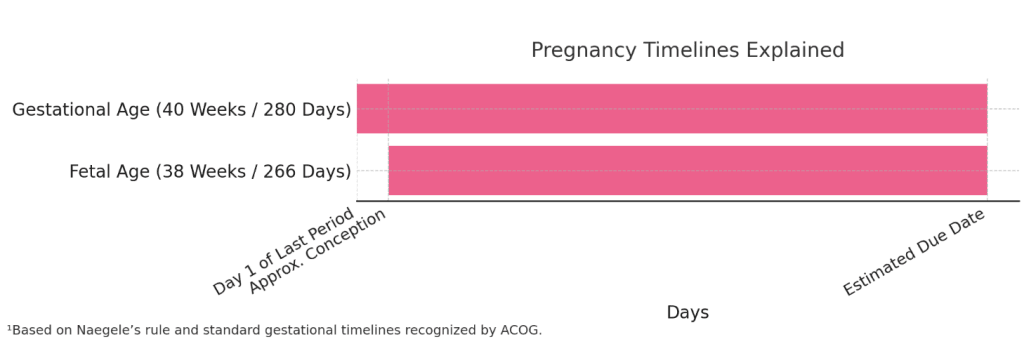
This estimation is based on Naegele’s rule and standard gestational timelines recognized by organizations like the American College of Obstetricians and Gynecologists (ACOG).
How the implantation window is estimated
After fertilization, the embryo travels down the fallopian tube and then attaches to the uterine lining. Research suggests that implantation usually happens:
- Earliest: about 6 days after conception
- Most common: around 9 days after conception
- Latest (typical): up to 12 days after conception
The calculator takes your estimated conception date and adds this range to show:
- A 6–12 day implantation window
- A “most likely” implantation day in the middle of that range
This can help you understand when hCG first started to rise, why certain pregnancy tests were positive or negative on specific days, and how your symptoms line up with the biology of early pregnancy.
Frequently Asked Questions
Is this conception date 100% accurate?
No. All conception dates generated by calculators are educated estimates.
Cycle length, late or early ovulation, variation in embryo development, and sperm survival (up to ~5 days) can all shift the true date by several days. An early ultrasound done in the first trimester is usually the most precise way to date a pregnancy, but even that has a margin of error.
Use this tool as a helpful guide, not as legal or medical proof of exactly when conception occurred.
Why does this calculator use 266 days instead of 280?
The traditional 280-day (40-week) timeline measures gestational age from the first day of your last period. But conception usually happens about two weeks later, around ovulation.
By subtracting 266 days from your due date, we’re estimating the actual fetal age—the point when sperm and egg met—rather than the start of your last cycle. This gives a more realistic estimate of the day pregnancy began, not just the day the pregnancy clock started.
How do I use an ultrasound date instead of a due date?
On the “Ultrasound” tab:
- Enter the date of your scan.
- Type the gestational age in weeks and days exactly as it appears on your report (for example, 8 weeks 5 days).
- Confirm the pregnancy length from LMP (usually 40 weeks).
The calculator uses this information to estimate your due date and then works backward to your LMP, conception date, and implantation window.
I know my ovulation, LH surge, or intercourse day. Can I use that here?
This tool is designed to reverse from a due date or ultrasound.
If you already know your ovulation day, LH surge, or an exact intercourse date, you can compare those days with the dates shown here to see how well they line up. For more precise planning based on ovulation or LH tests, you may also want a dedicated ovulation or conception-date calculator on your site.
What “week” of pregnancy is conception?
In gestational-age terms, conception happens around 2 weeks 0 days.
That’s because the first two weeks of the “40-week” pregnancy clock are actually pre-conception time—your period and the follicular phase leading up to ovulation. When this calculator shows your conception date, it’s pointing to the day that corresponds to gestational age 2w0d, give or take a few days.
I only remember my LMP. Can I still estimate conception?
Yes—if you know the first day of your last menstrual period and your typical cycle length, you can estimate when ovulation and conception most likely happened using a separate LMP-based ovulation or conception calculator.
For this tool, you’ll first need an estimated due date, which you can get from an LMP-based due date calculator and then plug into the “Due Date” tab here.
How does IVF or FET change the “conception date”?
For assisted reproduction, “conception” is often defined differently:
- Fresh IVF: conception is usually counted from the day of egg retrieval, when eggs and sperm are combined.
- Frozen embryo transfer (FET): clinics count back based on embryo age (for example, a 5-day embryo is treated as having “conceived” 5 days before transfer).
Our calculator assumes a natural-cycle timeline, so IVF and FET patients should interpret the dates as approximations for comparison only. Always follow the dating and due date provided by your fertility clinic.
Is this the same as an implantation calculator?
Not exactly. This tool’s primary job is to reverse your due date or ultrasound and estimate conception and fertile days.
However, it also includes an implantation window based on typical 6–12 day timing after conception. If you only care about implantation timing from LMP, ovulation, or a known conception date, a dedicated implantation calculator can give more tailored views.
Why might this tool show a different date than other websites?
Different calculators make different assumptions, such as:
- Using 280 days instead of 266 days
- Counting cycles with or without inclusive end dates
- Handling time zones differently
- Basing the due date strictly on LMP vs. early ultrasound
Because this calculator focuses on fetal age and implantation, it may give dates that are a day or two different from tools that only subtract 40 weeks from the due date.
Is this calculator free, and do you store my data?
Yes, this reverse due date & implantation calculator is free to use.
All calculations run in your browser based on the numbers you type in. We don’t use the input fields to personally identify you. Standard website analytics may still apply (for example, anonymous visit counts), so check the site’s privacy policy for full details.
Medical disclaimer
This calculator is an educational tool only. It can’t diagnose pregnancy problems, determine paternity, or replace medical advice.
If you have questions about your dates, your symptoms, or your pregnancy, talk with your doctor, midwife, or other licensed health-care professional. If you think you could be having a medical emergency, contact emergency services right away.